The Role of Storytelling in Cultural Rituals Worldwide in 2026
10 October 2026
Somewhere right now, a tour guide in Kyoto is telling a group of travelers that the tea ceremony is about "finding inner peace." Across the ocean, a guide in Oaxaca is explaining Day of the Dead as "Mexico's version of Halloween." And in a village in Ghana, a local elder is watching a tour bus pull up and quietly wondering why nobody asked him what the festival actually means.
This is the state of storytelling in cultural rituals as we approach 2026. We have more platforms, more cameras, more travel content than at any point in human history. And yet the stories being told about the world's most meaningful rituals are often thin, recycled, or flat-out wrong.
That is the problem this article addresses. Not in a hand-wringing, "everything was better before" way, but in a practical, here-is-what-works way. Storytelling is not decoration layered on top of a ritual. In many traditions, the story is the ritual. Remove it and you are left with costumes and choreography.
Let us get into what that actually means for the people who tell these stories for a living, and for the travelers who consume them.
Why Storytelling Is Not Optional in Cultural Rituals
A ritual without its narrative is just a sequence of actions. Someone lights a fire. Someone walks in a circle. Someone says words in a language you do not speak. Without the story, you are watching theater with the sound off.Take the Japanese tea ceremony, known as chanoyu. A visitor can watch the precise movements, the whisking, the bowing, the careful turning of the bowl. It looks beautiful. It also looks arbitrary. The story changes everything. The ceremony carries centuries of philosophy about impermanence, hospitality, and the beauty of things that are imperfect and incomplete. The bowl is often deliberately asymmetrical. The room is deliberately small. The guest enters through a low doorway that forces them to bow. None of that is random. Each detail encodes an idea.
Now imagine a guide who skips all of that and just says, "This is a traditional tea ceremony." The traveler takes a photo, drinks the tea, and leaves with nothing. The ritual was performed. The story was not transmitted. Something was lost.
This matters beyond sentimentality. UNESCO recognizes intangible cultural heritage precisely because practices can die when their meaning stops being passed on. Storytelling is the transmission mechanism. It is not a nice-to-have.
The Three Layers of Ritual Storytelling
Most cultural rituals carry stories at three distinct levels. Confusing them is one of the most common mistakes in cultural tourism.The Origin Story
This is the "why" layer. Why do people in this community perform this ritual? The origin story might be religious, historical, agricultural, or some blend of all three. The Chinese Dragon Boat Festival, for example, is tied in popular tradition to the story of Qu Yuan, a poet and statesman. The boat races, the rice dumplings, the timing of the festival all connect to that narrative.Origin stories are powerful but fragile. They get simplified fast. A nuanced tale about loyalty, political exile, and grief becomes "a guy jumped in a river." That version travels well on social media. It also strips the ritual of its emotional weight.
The Living Story
This is the "who" layer. What does the ritual mean to the people performing it right now, this year, in their actual lives? A young woman in Seville participating in Semana Santa might have a relationship to the procession that has nothing to do with medieval theology and everything to do with her grandmother, her neighborhood, and her own sense of identity.Living stories are the ones travelers rarely hear, because they require actual conversation. They also happen to be the most memorable. A traveler who hears a personal account of why someone walks in a procession will remember that long after they forget the historical dates.
The Visitor Story
This is the "you" layer, and it is where things get ethically tricky. What story is the visitor being invited into? Are they a guest, an observer, a participant, a customer? Different rituals answer this differently, and the answer is not always stated out loud.When a traveler shows up to a ceremony expecting to participate and the community expects them to watch quietly from a distance, you get friction. Good storytelling prevents that friction by setting expectations honestly before anyone arrives.
What Changed by 2026
The mechanics of cultural storytelling have shifted dramatically in the last few years, and anyone working in tourism needs to understand these shifts.The AI Narration Problem
Audio guides and apps now generate narration on demand. Type in "explain this festival" and you get a fluent paragraph in seconds. This is genuinely useful for logistics. It is genuinely dangerous for culture.Why? Because generated narration flattens. It averages. It takes the most common version of a story from the internet and presents it as settled fact. For rituals with contested meanings, multiple origin versions, or sacred elements that were never meant for public consumption, this creates real harm. Communities end up being explained to themselves by a machine that scraped a blog post.
The practical takeaway: use technology for logistics, translation, and accessibility. Do not use it as the primary source of cultural interpretation. Pay humans who hold the knowledge.
Short-Form Video as Ritual Gatekeeper
Short video platforms have become the front door to cultural rituals for a huge share of travelers. A fifteen-second clip of a fire festival or a masked dance can generate thousands of bookings. It can also generate thousands of people arriving with expectations shaped entirely by an edit.The rituals that survive this pressure best are the ones with clear boundaries. If a ceremony is closed to outsiders, say so loudly and early. If photography is forbidden during a specific moment, communicate that before tickets are sold, not at the gate. Ambiguity invites conflict.
The Return of the Local Narrator
The most encouraging shift is the rise of community-led storytelling. Instead of an outside guide interpreting a culture, the community trains its own narrators. This is slower to scale and harder to schedule. It is also the only version that consistently produces accurate, emotionally honest interpretation.If you are building a cultural tourism product in 2026, budgeting for local narrators is not a cost center. It is the product.
What Makes Ritual Storytelling Work
Not all storytelling is equal. Some approaches consistently land, and some consistently fail. Here is what separates them.Specificity Beats Grandeur
"We celebrate our ancestors" is a slogan. "My grandfather's chair is set at the table, and nobody sits in it, and my mother still talks to him while she cooks" is a story.The second version does something the first cannot. It gives the listener a concrete image to hold. Concrete images survive memory. Abstractions do not. This is why the best cultural guides talk about objects, smells, specific people, and small moments rather than sweeping statements about tradition.
Tension Is Not Disrespect
Many guides soften rituals to avoid discomfort. They skip the parts about death, sacrifice, grief, or conflict. This is a mistake.Rituals exist partly because life is hard. A festival that honors the dead exists because people die. A harvest ritual exists because crops fail sometimes. Removing the tension removes the reason the ritual exists. Visitors can handle complexity. What they cannot handle is being talked down to.
Silence Has a Place
The best storytellers in cultural contexts know when to stop talking. During a moment of prayer, a procession, or a blessing, narration can be an intrusion. Teaching visitors when to be quiet is itself a form of storytelling. It signals that something important is happening and that their attention, not their commentary, is what is requested.Common Mistakes and How to Avoid Them
Let us be blunt about the failures that show up again and again.Mistake One: The Universalizing Trap
"This ritual is basically the same as..." No. It is not. Comparing a specific tradition to a familiar Western holiday is a shortcut that erases meaning. Day of the Dead is not Mexican Halloween. Diwali is not Indian Christmas. These comparisons feel helpful and are actually corrosive.A better approach: explain the ritual on its own terms first. If a comparison helps afterward, use it carefully and note where it breaks down.
Mistake Two: The Frozen Culture Problem
Treating a culture as frozen in time is both inaccurate and insulting. Rituals evolve. Young people change them. Technology enters them. A guide who presents a tradition as unchanged for five hundred years is usually wrong and often performing a fantasy for tourists rather than describing a real community.Ask instead: how has this changed in your lifetime? That question almost always produces a better story than any historical summary.
Mistake Three: Over-Explaining the Sacred
Some things are not meant to be fully explained to outsiders. That is not secrecy for its own sake. It is a boundary. Pushing past it damages trust and can end access for everyone who comes after you.The professional move is to acknowledge the boundary out loud. "There is a part of this ceremony that is not shared with visitors, and I am going to respect that." Travelers respond well to honesty. They respond poorly to being managed.
Mistake Four: Ignoring the Economics
Storytelling in cultural tourism is not free. Narrators need to be paid. Communities need to benefit. If a ritual generates revenue and the community sees none of it, the storytelling is extraction, not interpretation.Before booking or promoting any cultural experience, ask who gets paid. If the answer is vague, that is your answer.
Practical Guidance for Different Audiences
The right storytelling approach depends entirely on who is listening and why.For Tour Operators
Build your interpretation around named people, not abstract traditions. Contract local narrators and pay them properly. Train your staff to handle the "is this like Halloween" question without condescension. Build in quiet moments. And please, stop writing marketing copy that calls every ritual "ancient." Some are. Many are not. Accuracy is a selling point.For Travelers
Ask questions that invite stories rather than confirm assumptions. "What does this mean to you?" works better than "So this is about good luck, right?" Accept that some questions will not be answered. Dress and behave according to local norms, not according to what looks good in photos. And if you are going to film, ask first. Every time.For Community Organizations
You do not have to open everything. Decide what is shareable and what is not, and hold that line even when it costs bookings. Train young people in your community to tell their own stories, including in languages that travelers understand. Document your own versions of your rituals before outsiders do it for you. Control the narrative or someone else will.For Content Creators
If you are making videos or writing about cultural rituals, cite the community, not just the country. Name the specific group, the specific town, the specific people who hosted you. Avoid the word "hidden" unless something is genuinely hard to find. And if you got a detail wrong, correct it publicly. Trust is built slowly and destroyed quickly.What the Future Probably Holds
Predictions are cheap, so treat these as possibilities rather than certainties.Community-owned digital archives may become a standard tool for protecting ritual knowledge while still allowing controlled access. Real-time translation could make local narrators viable for much larger audiences, which would be a genuine improvement over AI narration. And the pressure to compress rituals into short-form content will likely continue, which makes boundary-setting more important, not less.
The rituals that thrive will be the ones whose communities remain in control of their own stories. That is not a romantic statement. It is a structural one. Control the story and you control the terms of engagement. Lose it and you become scenery.
A Final Word on Getting This Right
Storytelling in cultural rituals is not about making things entertaining. It is about making things true. Entertainment is a byproduct of truth told well.The travelers who remember a ritual for decades are almost never the ones who got the most polished presentation. They are the ones who felt, for a moment, that they understood why someone else's life is shaped the way it is. That feeling does not come from a script generated overnight. It comes from a person who belongs to the tradition deciding to share something real with a stranger.
Protect that. Pay for that. And for the love of everything, stop calling things "ancient" when you have not checked.
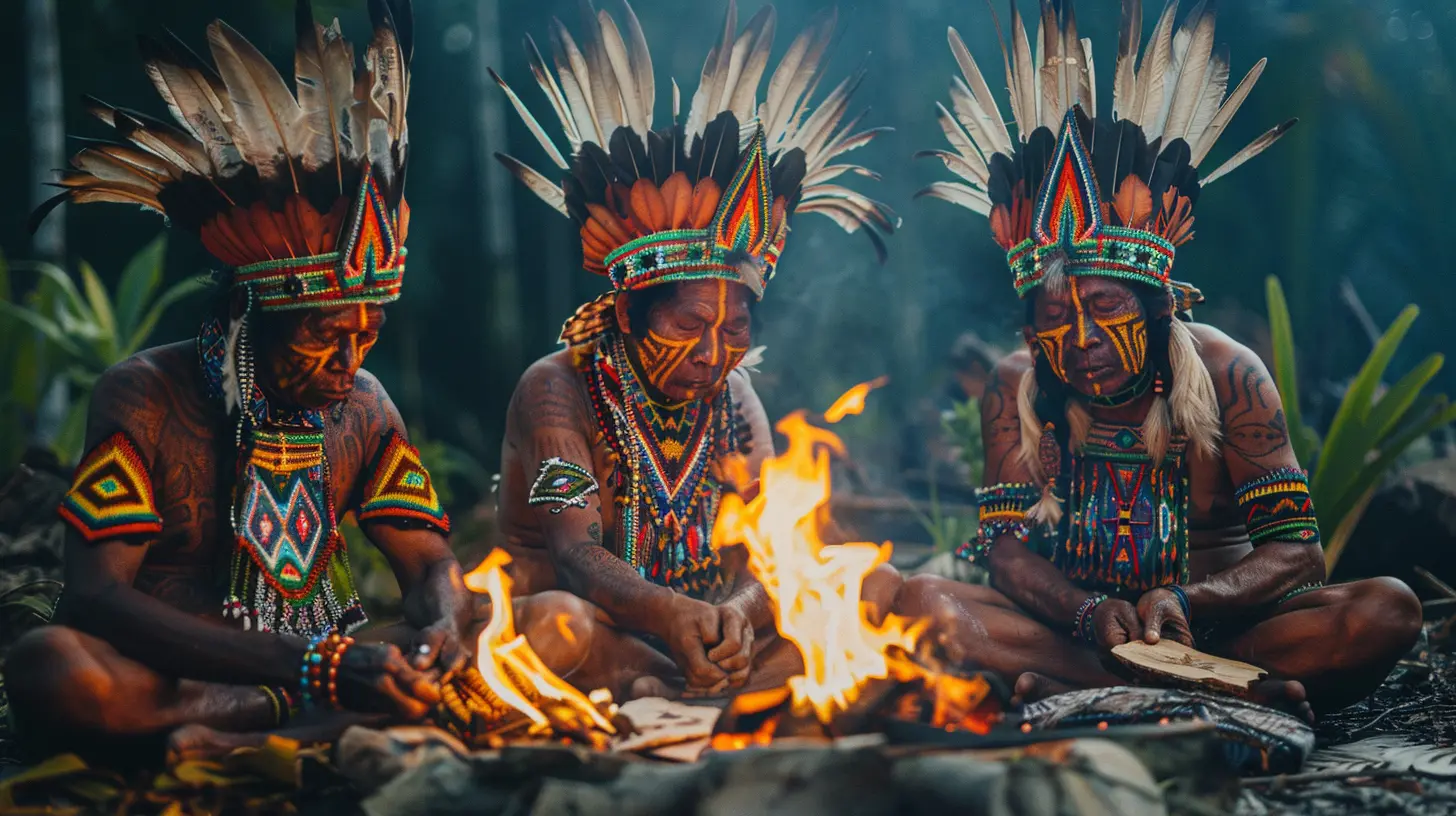
all images in this post were generated using AI tools
Category:
Cultural CelebrationsAuthor:

Shane Monroe